
The fastest way to find jobs in Ireland is to clarify your target role, update your CV and LinkedIn profile, then run a focused three-step outreach plan. You can start all three in under an hour. Here is what to do first:
- Define your target role — write one sentence describing the job title, sector, and location you want.
- Update two assets — revise your CV and LinkedIn summary to reflect that target role, using keywords from real job descriptions.
- Run targeted outreach — message three contacts who work in your target sector and ask for a brief conversation, not a job.
Jobsirish lists roles across every major Irish sector and lets you filter by location, industry, and contract type. The Career Intelligence section on Jobsirish provides skills-audit tools to help you define that first sentence quickly.
Table of Contents
- How do you find jobs in Ireland step by step?
- Where should you search for jobs in Ireland?
- How does networking and proactive outreach work in Ireland?
- How do you tailor your CV and LinkedIn to pass ATS screening?
- If you're hiring in Ireland: a short employer playbook
- Quick tools and templates to start today
- Why should you clarify your goals before searching?
- How do you tailor your CV and LinkedIn for each role?
- What makes strategic networking more effective than cold applying?
- Where do you search for jobs in the UK: boards, agencies, and the government portal?
- How do speculative applications and pre-interview projects help?
- What are the typical timelines and costs in a job search?
- What are the different UK employment contract types?
- How should you prepare for interviews in the UK?
- How do you negotiate a job offer and salary in the UK?
- How do apprenticeships and graduate schemes work as entry routes?
- What government employment support is available in the UK?
- What are your legal rights as a job seeker in the UK?
- Key takeaways
- The part of job searching most people underestimate
- Jobsirish: a practical option for hiring and searching in Ireland
- Further reading and practical links
How do you find jobs in Ireland step by step?
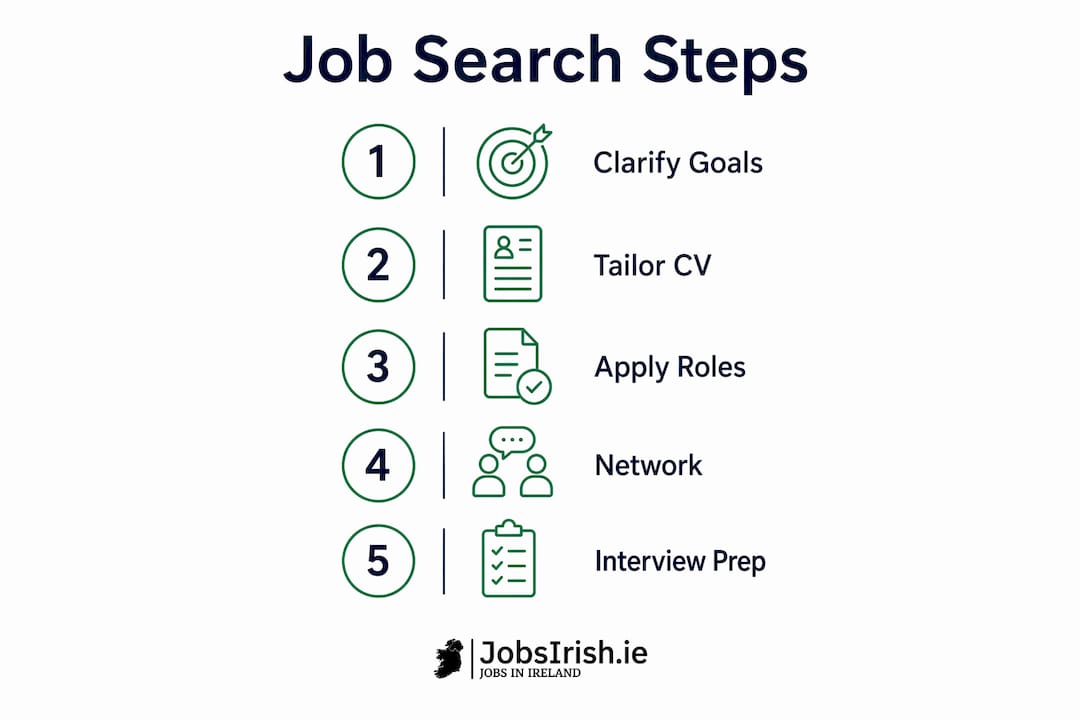
A structured 30-day plan produces more interviews than months of uncoordinated applications. The sequence matters: goals first, assets second, outreach third.
- Days 1–2: Clarify goals and inventory skills. List your top five transferable skills and match them to three to five job titles. Write one target-role sentence.
- Days 3–5: Shortlist target companies. Identify ten to fifteen employers in your sector. Check their careers pages directly.
- Days 6–7: Tailor your CV and LinkedIn. Mirror the language in real job descriptions. Update your LinkedIn headline and summary.
- Week 2: Begin applications and outreach. Aim for five tailored applications and three networking messages per week.
- Weeks 3–4: Follow up and iterate. Track every application. If response rates are low, revise your CV headline or outreach message.
Measurable weekly targets keep the search on track: five applications, three outreach messages, one informational conversation.
Pro Tip: Before you apply anywhere, clarify what you offer — career strategist Benjamin Todd notes that proving capability through a short pre-interview project or portfolio piece often prompts employers to create roles for strong candidates, even when none was advertised.

Where should you search for jobs in Ireland?
The most effective mix is a local job board, a professional network, the government jobs portal, and one or two sector-specific agencies. Each channel serves a different purpose.
- National job boards — Jobsirish covers roles across Ireland with filters for location, sector, and contract type, including remote jobs in Ireland.
- Professional networks — LinkedIn is the primary platform for professional roles; keep your profile current and use its job-alert function.
- Government portal — gov.uk's "Find a job" service lists publicly funded and civil service roles; the Irish equivalent is through the Department of Social Protection's employment services.
- Recruitment agencies — Hays and Michael Page handle specialist and senior placements; Reed, Totaljobs, and CV-Library cover a broad range of sectors across the UK and Ireland.
- Company careers pages — direct applications to employer sites often reach hiring managers faster than aggregator submissions.
- Apprenticeship and graduate schemes — Indeed (UK) and LinkedIn both list structured entry programmes; the Irish government's apprenticeship portal lists trade and professional schemes.
- Google Jobs — Google's job search aggregates listings from multiple boards; use the work-from-home filter and save searches for alerts.
| Channel | Best for | Cost to candidate | Speed | Remote-friendly |
|---|---|---|---|---|
| Jobsirish | Ireland-wide, all sectors | Free | Fast | Yes |
| Professional and senior roles | Free (premium optional) | Medium | Yes | |
| Hays / Michael Page | Specialist and senior hires | Free | Medium–fast | Varies |
| Reed / Totaljobs / CV-Library | Broad UK and Ireland search | Free | Fast | Yes |
| gov.uk / Dept. Social Protection | Public sector, civil service | Free | Slower | Limited |
How does networking and proactive outreach work in Ireland?
Warm introductions and referrals consistently outperform cold applications for generating meaningful leads. A referral bypasses initial screening and puts your name directly in front of a hiring manager.
- Identify five target contacts — people who work at your shortlisted companies or in your target sector.
- Request an informational interview — keep the ask specific: "I'd value 20 minutes to learn about your team's work. Would that be possible this month?"
- Use a precise one-sentence request when asking for an introduction: "Could you introduce me to [Name] at [Company]? I'm exploring roles in [area] and their team does exactly the kind of work I'm targeting."
- Follow up once after seven days if you receive no reply.
- Turn the conversation into a referral — at the end of an informational meeting, ask: "Is there anyone else you'd suggest I speak to?"
Pro Tip: Prepare a one-page brief before any outreach conversation: your target role, two or three relevant achievements, and a short portfolio link or project summary. Sharing it after the meeting keeps you memorable and gives the contact something concrete to forward.
How do you tailor your CV and LinkedIn to pass ATS screening?
Tailored assets combined with evidence of real work beat generic applications at every stage of screening. Most large employers use applicant tracking systems (ATS) to filter CVs before a human reads them.
- Mirror the exact job-title wording from the posting in your CV headline.
- Include three to five keywords from the job description in your skills section and work-history bullets.
- Quantify achievements where possible: numbers, percentages, or project outcomes.
- Add a portfolio link, GitHub profile, or project summary to your LinkedIn featured section.
- Update your LinkedIn "Open to Work" settings to match your target role and location.
For a practical step-by-step checklist, the CV tailoring guide at ResumeMint covers keyword alignment and ATS formatting in detail.
Interview prep timeline: 48 hours before, research the company and prepare three examples using the STAR method (Situation, Task, Action, Result). 24 hours before, rehearse answers aloud. One hour before, review the job description and your CV once more.
Irish employers typically offer permanent, fixed-term, temporary, or zero-hours contracts. Understand which type you are being offered before accepting: fixed-term contracts carry specific renewal rights under Irish employment law, and zero-hours arrangements have been significantly restricted since the Employment (Miscellaneous Provisions) Act 2018.
Key figure: Recruitment agencies can accelerate specialist hires significantly compared with direct advertising alone, particularly for technical and senior roles where the talent pool is narrow.
If you're hiring in Ireland: a short employer playbook
The fastest hires come from a blended approach: a targeted listing, active sourcing, and employee referrals running in parallel. Relying on a single channel extends time-to-hire.
Job brief template (copy and adapt):
- Role title and team: [e.g. Marketing Executive, Growth Team]
- Must-have skills: [three to five non-negotiable requirements]
- Business impact: [what this person will own or deliver in 90 days]
- Interview stages: [e.g. screening call → task → panel interview]
- Contract type and location: [permanent / fixed-term; on-site / hybrid / remote]
| Route | Typical cost | Speed | Best for |
|---|---|---|---|
| Direct listing (Jobsirish) | Paid listing package | Fast | Broad and local Irish roles |
| Promoted listing | Higher package tier | Fastest | Competitive or urgent roles |
| Recruitment agency (Hays, Michael Page) | % of salary (agency fee) | Medium–fast | Specialist or senior hires |
| Employee referral | Internal incentive only | Fast | Culture-fit and trusted hires |
Trial periods in Ireland are typically three to six months for permanent roles. Employers must provide a written statement of terms within five days of the start date under the Terms of Employment (Information) Acts.
Quick tools and templates to start today
The most useful starting templates are a CV document, an outreach message, a job brief (for employers), and an application tracker spreadsheet.
- CV template — use a clean single-column format; save as PDF before submitting.
- Outreach message template — subject: "Quick question — [Your Name]"; body: one sentence on who you are, one sentence on why you are contacting them, one precise ask.
- Job brief template — see the employer section above.
- Application tracker — a simple spreadsheet with the columns below.
| Column | Purpose |
|---|---|
| Company | Name of the employer |
| Role title | Exact job title applied for |
| Date applied | For follow-up timing |
| Contact name | Hiring manager or recruiter |
| Status | Applied / Interviewed / Offer / Rejected |
| Follow-up date | Seven days after application |
| Notes | Key details, interview feedback |
Store portfolio links, CV versions, and cover letters in a single folder (Google Drive or OneDrive) so you can attach the right version quickly.
Why should you clarify your goals before searching?
Searching without a clear target wastes time and produces unfocused applications. Clarifying your goals and inventorying your skills before you begin improves both targeting and the relevance of every application you submit.
Write down: the role title you want, the sector, your preferred location or remote preference, and the two or three skills you want to use most. That single exercise sharpens every subsequent step, from keyword choices on your CV to which companies you shortlist.
How do you tailor your CV and LinkedIn for each role?
Each application needs a version of your CV where the headline, skills section, and top bullet points reflect the language of that specific job description. Generic CVs rarely pass ATS filters.
On LinkedIn, update your headline to match your target role title, not your current job title. Use the "About" section to state what you do and what you are looking for. Recruiters search LinkedIn by keyword, so the words you use there determine whether you appear in their results.
What makes strategic networking more effective than cold applying?
Referrals and warm introductions reach hiring managers directly, often before a role is advertised. Structuring outreach to request introductions rather than jobs produces far better results than sending unsolicited applications.
The practical difference: a cold application competes with hundreds of others in an ATS queue. A referral from a trusted contact often lands directly in a hiring manager's inbox with a personal endorsement attached.
Where do you search for jobs in the UK: boards, agencies, and the government portal?
For UK-based roles, the primary channels are Indeed (UK), LinkedIn, Reed, Totaljobs, CV-Library, and the gov.uk "Find a job" service. Each covers a different segment of the market.
Indeed (UK) and LinkedIn aggregate the largest volume of listings and offer alert functions. Reed and Totaljobs are strong for mid-market and sector-specific roles. CV-Library holds a large database of active candidates and is widely used by UK recruiters. The gov.uk "Find a job" portal is the official route for public sector and government-funded positions. Hays and Michael Page handle specialist placements across finance, technology, legal, and professional services.
How do speculative applications and pre-interview projects help?
Employers sometimes create roles for high-quality candidates who approach them proactively. A speculative application, sent directly to a hiring manager with a relevant portfolio piece or short project brief, can prompt a conversation that a job board application never would.
A pre-interview project is a short, role-relevant deliverable: a one-page marketing plan, a code sample, a brief financial model. It demonstrates capability before the interview and gives the hiring manager something concrete to evaluate.
What are the typical timelines and costs in a job search?
For job seekers, most costs are optional. Professional CV writing services typically charge £100–£300 in the UK market. LinkedIn Premium costs around £30–£40 per month and provides access to InMail credits and applicant insights.
For employers, recruitment agency fees in the UK and Ireland are typically charged as a percentage of the placed candidate's first-year salary, commonly in the range of 15–25% for permanent roles. Direct job board listings cost significantly less. Jobsirish offers paid listing packages for employers; see the pricing packages page for current rates.
Time-to-hire varies by role and sector. Entry-level roles often move from posting to offer within two to four weeks. Senior or specialist roles can take six to twelve weeks, particularly when multiple interview stages are involved.
What are the different UK employment contract types?
Understanding your contract type before you sign protects your rights and sets clear expectations.
Permanent contracts offer ongoing employment with full statutory rights from day one, including unfair dismissal protection after two years of service.
Fixed-term contracts run for a defined period. Employees on fixed-term contracts have the same statutory rights as permanent staff. Under UK law, employees on successive fixed-term contracts for four or more years may be entitled to permanent status.
Temporary contracts are typically arranged through an agency and cover short-term needs. Agency workers gain equal pay and conditions after 12 weeks in the same role under the Agency Workers Regulations 2010.
Zero-hours contracts provide no guaranteed hours. Workers retain the right to accept or decline work, and since 2023 UK legislation has strengthened protections around exclusivity clauses in zero-hours arrangements.
How should you prepare for interviews in the UK?
UK interviews typically follow a competency-based or structured format. Employers expect candidates to provide specific examples, not general statements.
Prepare three to five STAR-method examples covering common competency areas: problem-solving, teamwork, communication, and handling pressure. Research the company's recent news, financial results (for listed companies), and stated values. Arrive or log on five minutes early. Send a brief thank-you email within 24 hours of the interview.
Dress code varies by sector. Financial services and law firms expect formal attire; technology and creative sectors are typically business casual. When in doubt, err towards formal.
How do you negotiate a job offer and salary in the UK?
Salary negotiation is expected and rarely damages an offer. The key is to anchor on market data, not personal need.
Research the typical salary band for the role using sources such as the Office for National Statistics Annual Survey of Hours and Earnings, or sector-specific salary surveys. When you receive an offer, take 24–48 hours to consider it. Respond with a specific counter-offer: "Based on my research and experience, I was expecting something closer to £X. Is there flexibility?" Most employers build a negotiation margin into initial offers.
Beyond base salary, consider pension contributions, annual leave entitlement, flexible working arrangements, and professional development budgets. These are all negotiable in most UK roles.
How do apprenticeships and graduate schemes work as entry routes?
Apprenticeships in the UK run from Level 2 (equivalent to GCSEs) through to Level 7 (postgraduate). They combine paid work with structured training and are available in sectors from accountancy and engineering to digital marketing and nursing. The gov.uk apprenticeship service lists all approved programmes.
Graduate schemes are structured two-to-three-year programmes offered by large employers across professional services, retail, technology, and the public sector. Applications typically open in September and October for the following year's intake. Early application is important: many schemes close before their advertised deadline once cohort places are filled.
What government employment support is available in the UK?
The UK government offers some employment support programmes through Jobcentre Plus and the Department for Work and Pensions. The Restart Scheme provides intensive employment support for those who have been out of work for nine months or more. The Skills Bootcamps programme funds short, flexible training courses in digital, technical, and green economy skills, with a guaranteed job interview on completion.
Universal Credit claimants who are actively seeking work can access work coach appointments and funded training through their local Jobcentre. The National Careers Service provides free careers guidance, CV support, and skills assessments to adults in England.
What are your legal rights as a job seeker in the UK?
Job seekers in the UK have clear legal protections throughout the recruitment process. Employers cannot discriminate on the basis of age, sex, race, disability, religion, sexual orientation, or pregnancy under the Equality Act 2010. Job advertisements must not contain discriminatory criteria.
You have the right to request reasonable adjustments during the recruitment process if you have a disability. Employers are not entitled to ask about your health or disability before making a conditional job offer, except in limited circumstances. If you believe you have been discriminated against during a recruitment process, you can raise a complaint with the Equality and Human Rights Commission or bring a claim to an Employment Tribunal.
This article provides general information about job-seeking and employment in the UK and Ireland. It is not legal or professional advice. Confirm current rules and your specific rights with a qualified employment solicitor or the relevant government authority.
Key takeaways
A structured search combining clear goals, tailored assets, and warm outreach produces interviews faster than volume applications alone.
| Point | Details |
|---|---|
| Clarify your target role first | Write one sentence defining your job title, sector, and location before updating any application materials. |
| Tailor every CV and LinkedIn profile | Mirror the exact keywords from each job description to pass ATS filters and reach human reviewers. |
| Prioritise warm outreach | Referrals and introductions reach hiring managers directly and bypass initial screening queues. |
| Understand your contract type | Permanent, fixed-term, temporary, and zero-hours contracts carry different rights; check before signing. |
| Use Jobsirish for Ireland-focused search | Jobsirish lists roles across Ireland with filters for location, sector, and contract type, free for candidates. |
The part of job searching most people underestimate
The conventional advice is to apply to as many roles as possible. The evidence points the other way. A smaller number of well-researched, tailored applications, backed by a short piece of relevant work, consistently outperforms high-volume generic submissions.
The same logic applies to employers. A precisely written job brief that states the business impact of the role, not just a list of requirements, attracts candidates who understand what they are being hired to do. Vague listings attract vague applicants.
At Jobsirish, the pattern we observe across the Irish market is consistent: the candidates who move fastest through recruitment processes are those who arrive prepared, specific, and able to point to something they have already done that is relevant to the role. That preparation takes a few hours. The return on that time is measurable.
Jobsirish: a practical option for hiring and searching in Ireland
Jobsirish gives Irish employers a direct route to local candidates without the cost of a recruitment agency. Post a role, manage applications, and promote your listing to reach more candidates across Ireland, all from a single platform. For job seekers, browsing is free: filter by location, sector, contract type, or remote preference to find relevant openings quickly.
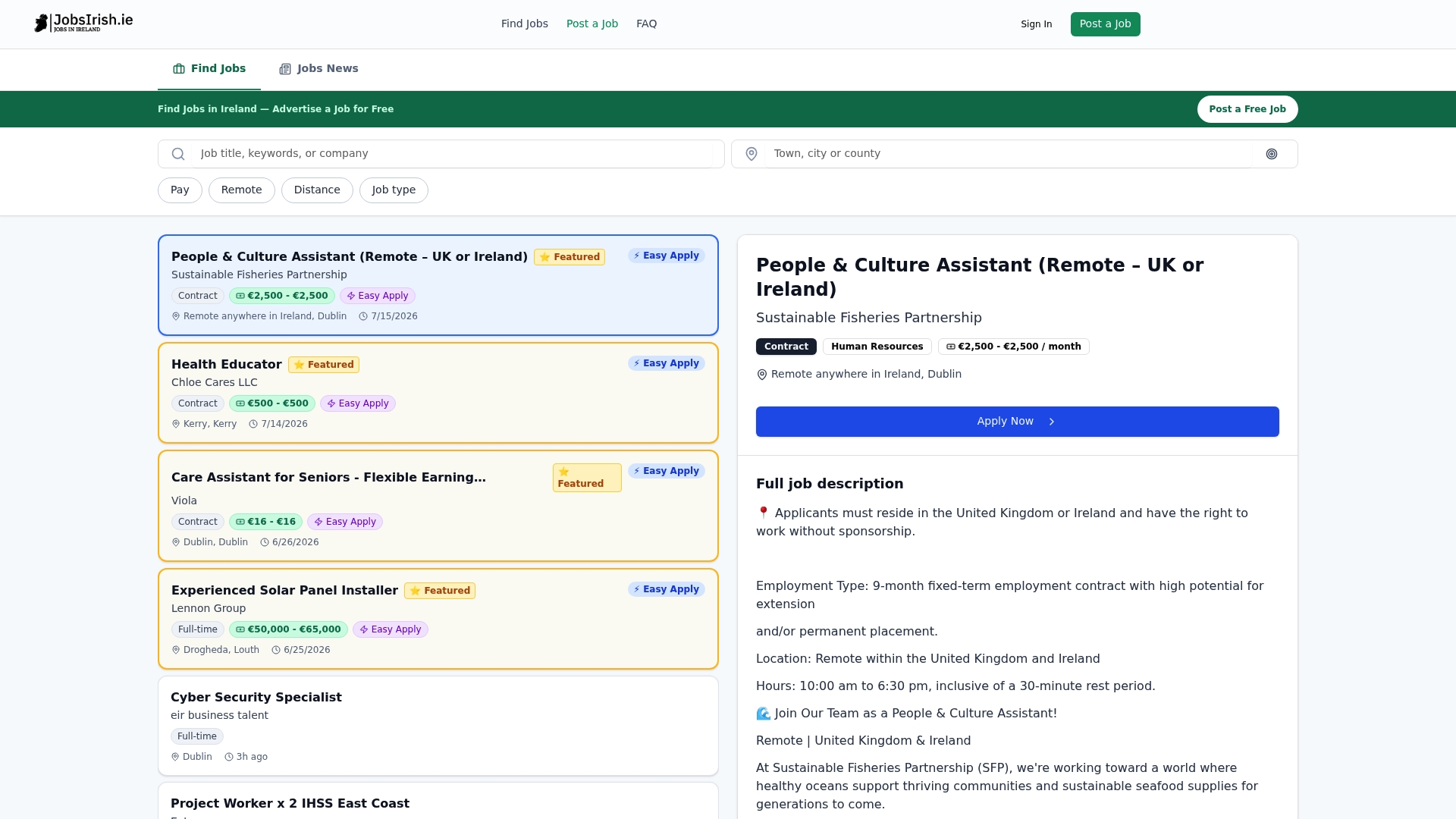
Employers can choose from listing packages that suit single hires or ongoing recruitment needs. The job board signup page walks through the options in a few minutes. Job seekers can browse current openings, including remote roles across Ireland, directly on the platform.
Further reading and practical links
These sources cover the key areas of job-search strategy, official portals, and CV preparation referenced throughout this guide.
- 80,000 Hours: How to get a job — covers warm outreach, pre-interview projects, and the three core stages of an effective search. Use it to structure your outreach strategy.
- CNN Business: job search strategies — practical guidance on clarifying goals and making precise introduction requests. Read before you write your first outreach message.
- ResumeMint: CV tailoring guide — step-by-step ATS keyword alignment and formatting checks. Work through it before submitting any application.
- Google Jobs search help — explains how to use location filters, work-from-home options, and saved searches. Set up alerts for your target role title.
- Jobsirish Employers Directory — browse hiring organisations listed on the platform to research employers and identify direct application targets.