
Use a defined workflow, basic automation, and a small set of KPIs to manage job applications from post to offer without losing strong candidates to slow review cycles. Post your role on Jobsirish, enable an automated acknowledgement message, and set a fixed short review window before your first screen. These three steps alone reduce the most common bottleneck: applications sitting untouched while candidates accept offers elsewhere.
- Simplify your intake form. Remove every field that is not needed for an initial screen. Shorter forms on mobile convert better and reduce drop-off before a candidate even submits.
- Switch on automated acknowledgement. Send a confirmation message the moment an application is received. Candidates contacting multiple employers simultaneously will stay engaged if they hear back quickly.
- Fix a daily review window. Block time each morning to triage new applications. Delayed review is one of the most common causes of losing high-quality candidates in high-volume hiring.
Table of Contents
- Five quick checklist items to improve application handling today
- What does an end-to-end application workflow look like?
- Which tools and automation features actually reduce manual work?
- Which KPIs should you track to monitor pipeline health?
- How do you manage surges without losing strong candidates?
- How do you keep candidates engaged while meeting UK data-protection obligations?
- How does Jobsirish support each step of this workflow?
- How do you reduce candidate drop-off after the first contact?
- Key takeaways
- A note on fair hiring in Ireland
- Practical resources to read next
- Post your next role on Jobsirish today
Five quick checklist items to improve application handling today
Good candidate pipeline management starts with a few practical habits, not a complex system.
- Mobile-friendly application form — test your form on a phone before publishing. A form that breaks on mobile cuts your applicant pool immediately.
- Auto-acknowledgement message — set this up on your platform before the role goes live. Immediate automated communication prevents loss of candidates who are applying to multiple employers at the same time.
- One standard screening question — add a single knock-out question (right-to-work status, required qualification, or availability date) to filter noise at intake without adding friction.
- Daily 48-hour review window — commit to reviewing new applications promptly. Track this as your first internal SLA.
- Pipeline stage tags — label each application (New, Screened, Shortlisted, Interview, Offer, Closed) from day one. Monitor how many applications move promptly from New to Screened..
What does an end-to-end application workflow look like?
A reliable workflow moves every candidate from posting to onboarding through six defined stages, each with a time target. Here is the recommended sequence with suggested durations:
| Stage | Key actions | Suggested duration |
|---|---|---|
| Post | Write clear job description, set screening question, publish on Jobsirish | Day 1 |
| Screen | Review applications against knock-out criteria, tag pipeline stages | Days 2–5 |
| Shortlist | Score against skills fit, availability, salary alignment, and cultural fit | Days 4–7 |
| Interview | Schedule via calendar integration, confirm with automated reminders | Days 7–14 |
| Offer | Issue written offer, set acceptance deadline, follow up if no response in 48 hours | Days 14–17 |
| Onboard | Send pre-start documentation, right-to-work check, first-day confirmation | Days 17–21 |
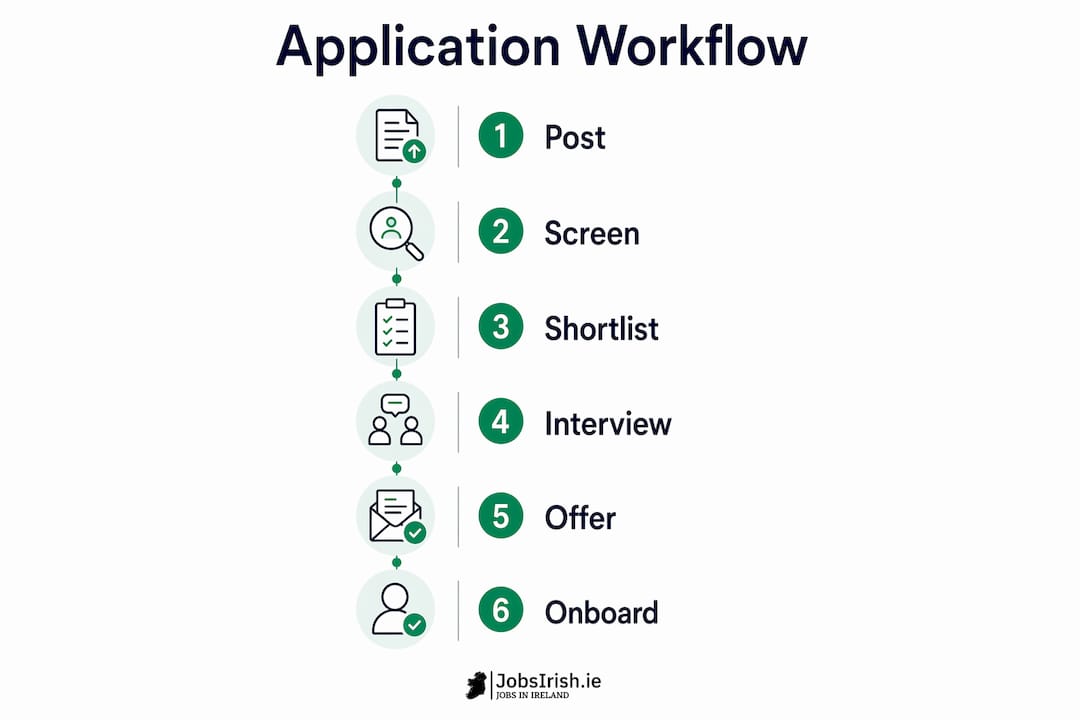
The shortlist scorecard is the step most teams skip. Score each candidate on four criteria: skills fit (does the CV match the role requirements?), availability (can they start within your window?), salary alignment (is their expectation within budget?), and cultural fit (based on a brief phone screen). A simple 1–3 score per criterion gives you a defensible ranking before the interview stage.
Proactive pipeline-building before a role opens reduces pressure at the screen stage. Building candidate pools ahead of hiring spikes means you enter the screen stage with pre-engaged candidates rather than a cold backlog.

Which tools and automation features actually reduce manual work?
The features that matter most map directly to the workflow stages above. Here is what to use and why:
- Mobile-optimised intake forms — reduces drop-off at the post stage; candidates on phones complete shorter, well-formatted forms at a higher rate.
- Stage tagging and bulk actions — lets you move multiple applications through the pipeline at once; cuts manual admin at the screen and shortlist stages.
- Candidate CRM-style nurture — segmentation using tags and filters allows targeted follow-up (job alerts, role updates) for candidates who were not selected but remain strong prospects.
- Auto-acknowledgements and scheduled communications — removes manual email at intake and keeps candidates informed without recruiter effort.
- Calendar integration for interview booking — sends automated reminders and reduces interview no-shows, which is one of the most common causes of wasted recruiter time at the interview stage.
- Reporting dashboards — surface bottlenecks weekly; if applications are stacking at the screen stage, the dashboard shows it before candidates disengage.
Pro Tip: Set a rule for when automation acts alone versus when a human must review. Auto-reject only on hard knock-out criteria (e.g. no right-to-work in Ireland). Queue everything else for human review. Automation handles volume; a recruiter handles judgement.
Which KPIs should you track to monitor pipeline health?
The four must-track metrics are time to hire, application completion rate, quality of hire, and pipeline conversion rate. Together they tell you where candidates are dropping off and whether the process is producing good outcomes.
| KPI | How to calculate | What a bad signal looks like |
|---|---|---|
| Time to hire | Days from application received to offer accepted | More than two weeks signals a bottleneck at screen or interview |
| Application completion rate | Completed applications ÷ form starts × 100 | Below 60% suggests the form is too long or not mobile-friendly |
| Quality of hire | % of new hires rated satisfactory or above at review | Declining scores suggest shortlist criteria need tightening |
| Pipeline conversion rate | Candidates advancing per stage ÷ total at that stage × 100 | A sharp drop at any single stage reveals where friction sits |
Benchmark to watch: If your application completion rate is low, the most likely cause is a form that does not work well on mobile. Mobile-friendly intake paired with immediate automated messages prevents loss of candidates who are applying to multiple roles simultaneously. Fix the form before adjusting anything else in the workflow.
ATS and CRM tools are the standard way to track these metrics without manual spreadsheets. Most platforms surface time to hire and conversion rate automatically once stage tags are in use.
How do you manage surges without losing strong candidates?
Prioritising candidates by readiness is more effective than filtering them out at the top of the funnel. Filtering removes candidates; ranking surfaces the best ones faster.
- Switch to mobile-first intake immediately. In high-volume periods, most applications arrive via phone. A desktop-only form loses candidates before you see them.
- Add adaptive prescreen questions. Use two or three short questions that separate high-intent applicants from speculative ones. Keep them brief.
- Rank continuously, not in batches. Review and rank applications daily rather than waiting for the posting to close. Resumes can sit untouched for days in high-volume hiring, and strong candidates move on.
- Run a short daily triage session. Fifteen minutes each morning to tag new applications keeps the pipeline live and prevents backlogs.
- Build your pipeline before the spike. Proactive sourcing and nurturing before a role opens means you have pre-engaged candidates ready when volume hits.
Pro Tip: Automate the first triage layer: flag applications that meet all hard criteria and send them directly to a shortlist queue. A recruiter then reviews only that queue, not the full inbox. This keeps fairness intact because the criteria are set by a human before automation runs.
How do you keep candidates engaged while meeting UK data-protection obligations?
Keeping candidates informed at every stage reduces drop-off and protects your employer reputation. The practical steps are straightforward: send an acknowledgement within minutes of receipt, give a clear timeline in that first message ("we will be in touch within five working days"), and confirm next steps after every stage decision. Continuous engagement via targeted content and personalised outreach reduces time-to-fill compared with reactive approaches. For candidates not selected at shortlist, a brief, respectful decline message keeps the door open for future roles.
UK data-protection baseline: Under UK GDPR, you must have a lawful basis for processing candidate data (legitimate interest or consent), store applications securely, and not retain personal data longer than necessary. Most employers set a retention period of six to twelve months for unsuccessful applications. Right-to-work checks must be completed before employment begins, in line with Home Office guidance. Review the ICO's recruitment guidance for the current requirements specific to your organisation.
This article provides general information, not legal advice. Confirm current obligations with the ICO or a qualified employment law adviser for your specific situation.
How does Jobsirish support each step of this workflow?
Jobsirish supports posting, intake, basic application tracking, and candidate communication for Irish employers in one place. The platform is built for the Irish labour market, covering roles across all counties and sectors.
- Job posting — publish a role directly from your employer account; listings are searchable by location, sector, and job type across Ireland.
- Application inbox — applications arrive in a managed inbox, giving you a single place to review and respond without switching between email and spreadsheets.
- Promoted listings — listing packages give your role greater visibility to active candidates, which matters most during high-volume periods when competition for attention is high.
- Employers directory — your company profile on the employers directory builds brand presence with candidates before they apply.
To start posting and managing applications, sign up on Jobsirish. The platform home page at jobsirish.ie has full details on packages and features.
How do you reduce candidate drop-off after the first contact?
Most drop-off happens not at the application stage but in the days between stages, when candidates hear nothing and assume the process has stalled. The fix is a structured follow-up sequence.
Send a stage-update message within 24 hours of any decision, even if the decision is "still reviewing." Candidates who know where they stand stay in the process. For candidates in a shortlist or interview queue, a brief check-in every three to five days maintains engagement without becoming intrusive.
Active nurturing differentiates a good pipeline from a static database. Keep silver-medallists (strong candidates not selected for this role) in a separate tagged group and contact them when a relevant role opens. Successful pipelines continuously re-qualify talent via informal touchpoints rather than relying on the original application data alone. A brief message asking whether a candidate's availability or interests have changed takes two minutes and keeps your pipeline accurate.
For roles that attract high volumes, segment your pipeline by readiness tier: candidates ready to start now, candidates available in 30–60 days, and candidates to revisit in the next quarter. Segmentation using tags and filters allows targeted outreach at each tier without manual sorting.
Key takeaways
A structured workflow, basic automation, and four KPIs are sufficient to manage job applications reliably and reduce candidate drop-off at every stage.
| Point | Details |
|---|---|
| Fix a short review window | Review every new application promptly to prevent the most common pipeline bottleneck. |
| Track four KPIs | Monitor time to hire, application completion rate, quality of hire, and pipeline conversion rate weekly. |
| Rank by readiness, not rejection | Surface high-intent candidates first rather than filtering the pipeline down from the top. |
| Nurture beyond the first contact | Send stage updates within 24 hours and keep silver-medallists in a tagged group for future roles. |
| Use Jobsirish for Irish hiring | Post, manage applications, and promote listings in one place via jobsirish.ie. |
A note on fair hiring in Ireland
Jobsirish exists to connect Irish employers with candidates across every county and sector, from entry-level roles in Dublin to engineering positions in Cork. The Irish labour market is competitive, and the employers who hire well are those who treat the application process as the candidate's first experience of the company. A slow, silent process loses good people before the first interview. A clear, timely one builds a reputation that attracts stronger applicants over time.
The guidance in this article reflects what works in practice: a defined process, a small number of metrics, and consistent communication. Jobsirish is designed to support that process for Irish employers, whether you are hiring one role or running a continuous pipeline. If you have questions about posting or managing applications on the platform, the team is available via the About Us page.
Practical resources to read next
- Candidate pipeline management: best practices for talent teams — source for readiness-ranking and segmentation tactics used in the workflow and high-volume sections.
- A comprehensive guide to candidate pipeline management — source for KPI definitions, mobile intake, and nurture sequence recommendations.
- Candidate pipeline management in high-volume hiring — source for delayed-review data and triage automation guidance.
- Your guide to talent pipeline management — source for proactive nurturing and time-to-fill reduction.
- What is a candidate pipeline? — source for continuous re-qualification and pipeline-as-conversation principles.
- ICO recruitment and employment guidance — primary source for UK GDPR obligations in recruitment, data retention, and right-to-work compliance.
Post your next role on Jobsirish today
Jobsirish gives Irish employers a direct route to active candidates without the cost or complexity of a recruitment agency. Post a role, manage your application inbox, and promote your listing to reach more candidates across Ireland, all from a single employer account.
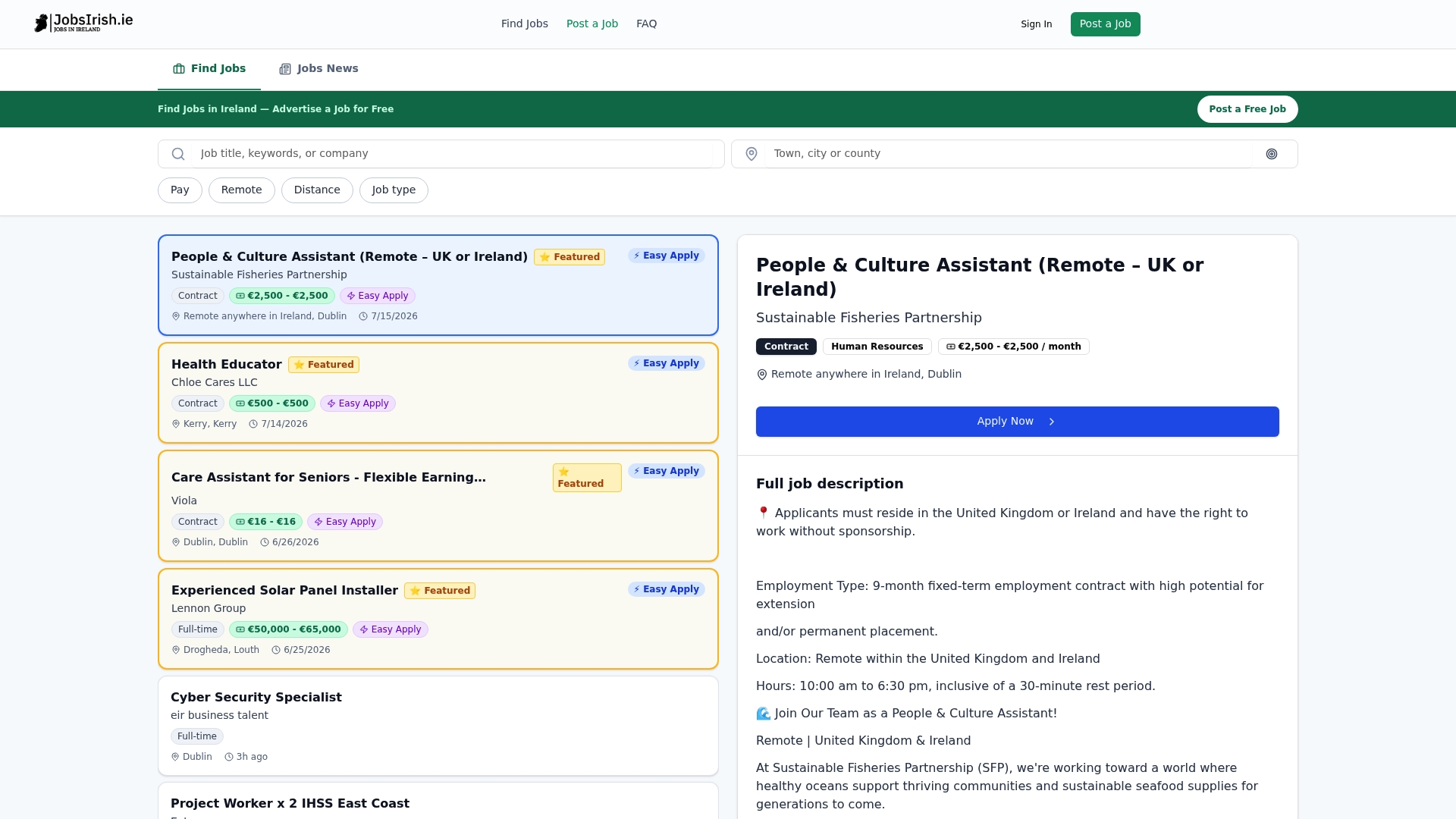
The listing packages are straightforward: choose the level of visibility that fits your hiring volume, publish your role, and start receiving applications the same day. There are no long-term contracts and no per-application fees. For employers hiring across multiple locations or sectors, promoted listings put your role in front of candidates searching by county, job type, or experience level.
Sign up on Jobsirish to post your first role and put the workflow in this guide to work immediately.