
If you are searching for parental leave in Ireland, the rules that apply depend on where you work. Employees based in the Republic of Ireland are covered by Irish employment law, administered through Citizens Information and the Department of Social Protection. Employees based in Great Britain fall under UK statutory rules set out on gov.uk and enforced by ACAS. Both frameworks are covered below.
Key facts at a glance:
- Irish employees are entitled to unpaid parental leave per eligible child
- Parent's Benefit (Ireland) covers paid leave in the first year of a child's life
- Paternity Benefit in Ireland is paid weekly for two weeks
- UK employees should check gov.uk and the Department for Work and Pensions (DWP) for current statutory pay rates
- Both employers and jobseekers should check the employer's written policy, as enhanced contractual terms often exceed the statutory floor
Next step for employers: review your written leave policy against the statutory minimums below and confirm payroll processes for state benefit interactions. Next step for jobseekers: check your contract or staff handbook before assuming your entitlement matches the statutory default.
Table of Contents
- What parental leave in Ireland covers and who qualifies
- Which leave is paid and how employer top-ups work
- How to book leave: notice periods and application steps
- What legal protections apply while you are on leave
- What employers should do: policy, payroll, and recruitment
- Planning checklist and template wording
- Key takeaways
- Why family-friendly hiring matters more than most employers realise
- Jobsirish makes it straightforward to advertise family-friendly roles
- Useful sources
What parental leave in Ireland covers and who qualifies
The terminology in Irish law causes genuine confusion. Parental leave and Parent's Leave are two separate entitlements, and conflating them is the most common planning error made by both HR teams and employees.
Irish leave types, side by side:
- Parental leave (unpaid): up to 26 weeks per child, available to parents of children under 12 (under 16 if the child has a disability). Requires one year's continuous service with the current employer in most cases.
- Parent's Leave (paid via state benefit): nine weeks per parent, to be taken within the first 24 months after birth or adoption placement. Funded by Parent's Benefit from the Department of Social Protection.
- Paternity leave: two weeks, available from the first day of employment regardless of hours worked. No minimum service requirement.
- Maternity leave: 26 weeks' ordinary leave plus 16 weeks' additional unpaid leave, with Maternity Benefit payable for the first 26 weeks subject to PRSI conditions.
- Adoptive leave: available to one parent of an adoptive couple; the other parent may take paternity leave.
For the one-year service rule on parental leave, there is a pro-rata exception. Where a child is approaching the age limit and the employee has between three months and one year of service, they are entitled to one week's leave for every month of continuous employment completed. Employers can also waive the one-year requirement entirely, and many do as part of retention policy. Always check the staff handbook.
UK equivalent: Shared Parental Leave, Statutory Maternity Pay, and Statutory Paternity Pay are governed by separate rules. Check gov.uk and ACAS for current eligibility thresholds and pay rates, as these are updated periodically.
Pro Tip: Ask for the employer's written parental leave policy before accepting a job offer. Statutory entitlements are the floor, not the ceiling, and many employers offer paid top-ups or extended leave periods that are not advertised in the job listing.
Which leave is paid and how employer top-ups work

Parental leave in Ireland is unpaid. The state benefit schemes that run alongside it are separate claims, and missing the application windows costs real money.
Paid state schemes in Ireland:
- Parent's Benefit: up to nine weeks, applied for via MyWelfare. The application must be submitted within six months of taking the leave. A verified MyGovID account is required.
- Paternity Benefit: €299 per week for two weeks, claimed via MyWelfare at least four weeks before leave starts (12 weeks if self-employed).
- Maternity Benefit: paid by the Department of Social Protection subject to PRSI contribution conditions; the rate is set by the DSP and should be confirmed on gov.ie before planning.
PRSI contributions determine eligibility for all three benefit schemes. Employees who have not accumulated sufficient contributions, or who have gaps in their record, may not qualify even if they meet the employment service requirements. Employees who have worked in another EU country can combine their foreign social insurance record with Irish PRSI contributions to meet the threshold.
Enhanced employer policies, where the employer tops up state benefit to full or partial salary, are increasingly common across Irish employers as a retention tool. Jobseekers should ask about paid top-ups during interviews; this is now a standard negotiation point in sectors competing for talent, and career intelligence resources can help candidates understand what to ask.
Pro Tip: Payroll teams should synchronise leave start dates with MyWelfare claim submissions. Missing the six-month window for Parent's Benefit is a common and entirely avoidable error.
Statistic: Paternity Benefit is paid at €299 per week for two consecutive weeks. Applications must be submitted at least four weeks before the leave start date (or 12 weeks for self-employed claimants).
How to book leave: notice periods and application steps
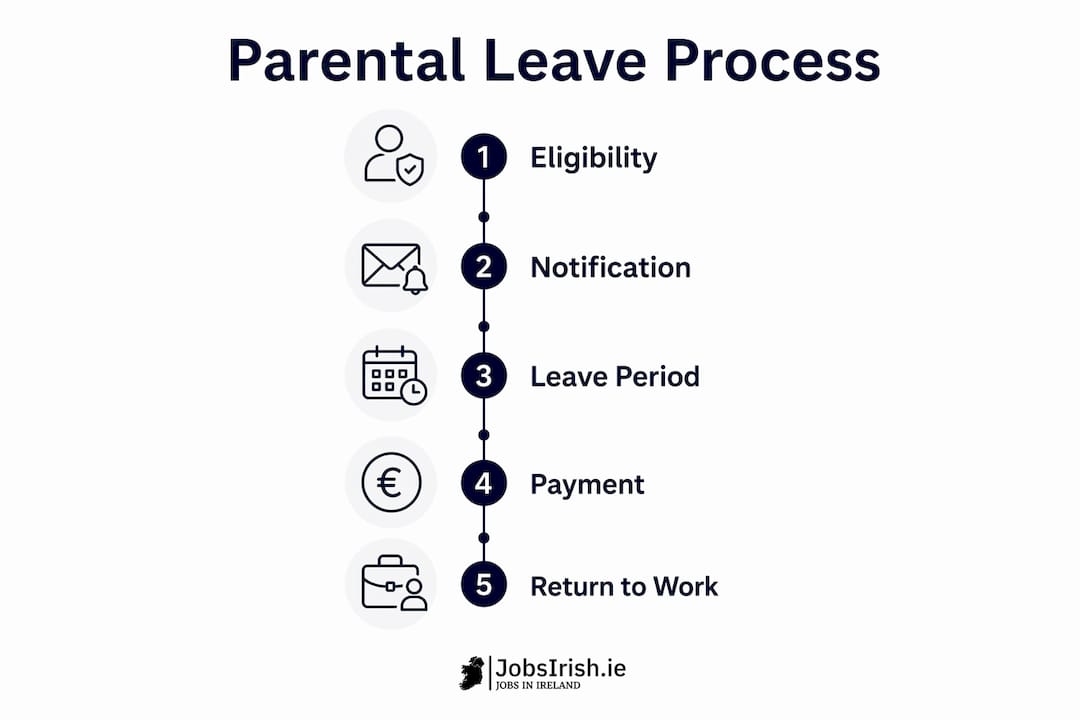
Both employees and HR teams need to follow a defined sequence. Getting the timing wrong can delay state payments or give the employer grounds to postpone leave.
For employees taking parental leave in Ireland:
- Give written notice to your employer at least six weeks before the intended start date.
- Agree and sign a confirmation document with your employer at least four weeks before leave begins.
- Apply for any relevant state benefit (Parent's Benefit, Paternity Benefit) via MyWelfare, within the required window.
- Keep copies of all written notices and confirmation documents.
- If your employer postpones leave, request the written explanation they are legally required to provide.
For paternity leave specifically: notify your employer in writing at least four weeks before the leave start date and provide a doctor's certificate confirming the expected or actual date of birth. For adoption, provide a certificate of placement.
Employer postponement: an employer may postpone parental leave by up to six months if granting it would cause a substantial adverse effect on the business. The postponement must be explained in writing; it can only be used once per leave request. Failure to provide written reasons is a frequent escalation point to the Workplace Relations Commission.
UK notice rules: UK employees taking Shared Parental Leave must give at least eight weeks' written notice. Check ACAS and gov.uk for the specific forms and curtailment notice requirements, as these differ from the Irish process.
Pro Tip: Template the written notice and confirmation document in your HR system. Having a standard form reduces errors and creates a clear audit trail if a dispute reaches the WRC.
What legal protections apply while you are on leave
Employment rights do not pause during statutory leave. The Workplace Relations Commission is clear on this: seniority, annual leave accrual, and all contractual terms continue throughout any statutory leave period.
Core protections for employees:
- The right to return to the same role on the same terms after parental or paternity leave
- Continuous accrual of annual leave entitlements during the leave period
- Protection of pension contributions and seniority where these are contractually provided
- Protection against dismissal or penalisation for taking statutory leave
"The employment rights of the employee are protected while on parental leave, and the employee has the right to return to work after such an absence." — Workplace Relations Commission, Guide to the Parental Leave Acts
Where returning to the exact same role is not practicable, the employer must offer a suitable alternative role on terms no less favourable. Employees should document their role and terms in writing before leave begins, and request written confirmation of their return date and position from HR.
Citizens Advice and ACAS provide equivalent guidance for UK employees. If a dispute arises in Ireland, complaints to the WRC must be made within six months of the incident, with a possible extension of a further six months where reasonable cause for delay exists.
What employers should do: policy, payroll, and recruitment
A written policy that reflects current statutory minimums is the starting point. Everything else follows from that.
Policy checklist:
- Confirm the policy covers all leave types: parental, Parent's Leave, paternity, maternity, and adoptive leave
- State the notice requirements and confirmation document process clearly
- Include the postponement procedure and a standard postponement letter template
- Document any enhanced terms (paid top-ups, extended leave periods) separately from the statutory floor
- Name a specific HR contact for employees planning leave
Payroll and benefits steps:
- Verify the employee's PRSI record before confirming benefit eligibility.
- Confirm the employee has a verified MyGovID account before leave starts.
- Align payroll run dates with the state benefit payment schedule to avoid gaps.
- Record all leave dates and benefit claims in the HR system.
- Process any employer top-up payments separately from state benefit amounts.
Recruitment angle: advertising family-friendly benefits in job listings attracts candidates who prioritise work-life balance. A short line in a job description, such as "enhanced parental leave policy available," signals culture as much as it signals compliance. Employers listing roles on Jobsirish can include policy highlights directly in the listing description to reach candidates actively searching for family-friendly employers.
Pro Tip: Enhanced parental leave policies are increasingly a retention lever, not just a compliance requirement. Advertising them in job listings costs nothing and differentiates the employer in competitive hiring markets.
Planning checklist and template wording
Employee checklist
- Confirm your length of service and check whether the one-year rule applies
- Obtain your PPSN and check your PRSI contribution record via MyWelfare
- Create or verify your MyGovID account well before the leave date
- Submit written notice to your employer at least six weeks before leave starts
- Sign the confirmation document with your employer at least four weeks before leave starts
- Apply for Parent's Benefit or Paternity Benefit via MyWelfare within the required window
- Keep copies of all correspondence, forms, and confirmation documents
Employer checklist
- Acknowledge the employee's written notice in writing within a reasonable time
- Prepare and sign the confirmation document at least four weeks before leave starts
- Verify PRSI eligibility and confirm the employee's MyGovID status
- Update payroll records with leave start and end dates
- If postponing, issue a written explanation immediately and agree a revised date
- Record the leave in the HR system and notify the relevant line manager
Employee leave request template:
Dear [Manager's name], I am writing to give notice that I intend to take parental leave from [start date] to [end date], a total of [X] weeks. I request that we prepare and sign a confirmation document no later than four weeks before the leave begins. Please confirm receipt of this notice. Yours sincerely, [Name]
Employer confirmation note:
Dear [Employee's name], This letter confirms receipt of your parental leave notice dated [date]. Your leave is confirmed from [start date] to [end date]. A confirmation document will be prepared and signed by [date, at least four weeks before start]. Your point of contact during this process is [HR contact name].
Key takeaways
Parental leave in Ireland gives employees unpaid leave per child, with separate paid schemes (Parent's Benefit and Paternity Benefit) requiring timely MyWelfare applications and sufficient PRSI contributions.
| Point | Details |
|---|---|
| Confirm jurisdiction first | Irish law applies to employees in the Republic; UK employees follow gov.uk, DWP, and ACAS rules. |
| Know the leave types | Parental leave (unpaid, 26 weeks) and Parent's Leave (paid, 9 weeks) are separate entitlements with different rules. |
| Apply for benefits on time | Parent's Benefit must be claimed within six months; Paternity Benefit applications are due at least four weeks before leave starts. |
| Give correct notice | Employees must give six weeks' written notice and sign a confirmation document at least four weeks before leave begins. |
| Use Jobsirish to recruit | Employers can highlight enhanced parental policies in listings on Jobsirish to attract candidates who prioritise family-friendly workplaces. |
Why family-friendly hiring matters more than most employers realise
The conventional view is that parental leave policy is a compliance matter, something to get right to avoid a WRC complaint. That framing misses the bigger picture. Candidates increasingly filter employers by leave policy before they apply, not after they receive an offer. An employer that buries enhanced terms in a contract, rather than advertising them in the job listing, loses candidates who never even click through.
There is also a retention argument that HR teams underweight. The cost of replacing an employee who leaves because a competitor offered better parental terms is almost always higher than the cost of the top-up itself. Advertising enhanced policies on a platform like Jobsirish, where candidates are actively searching by role type and location, puts that information in front of the right people at the right moment.
The gap between what Irish employment law requires and what the best employers actually offer is widening. Statutory minimums are the floor. The employers winning the talent competition are the ones treating family-friendly policy as a recruitment asset, not a legal obligation.
Jobsirish makes it straightforward to advertise family-friendly roles
Employers advertising roles with strong parental leave policies deserve a platform that lets those benefits show up in the listing, not buried in a PDF attached to an application form.
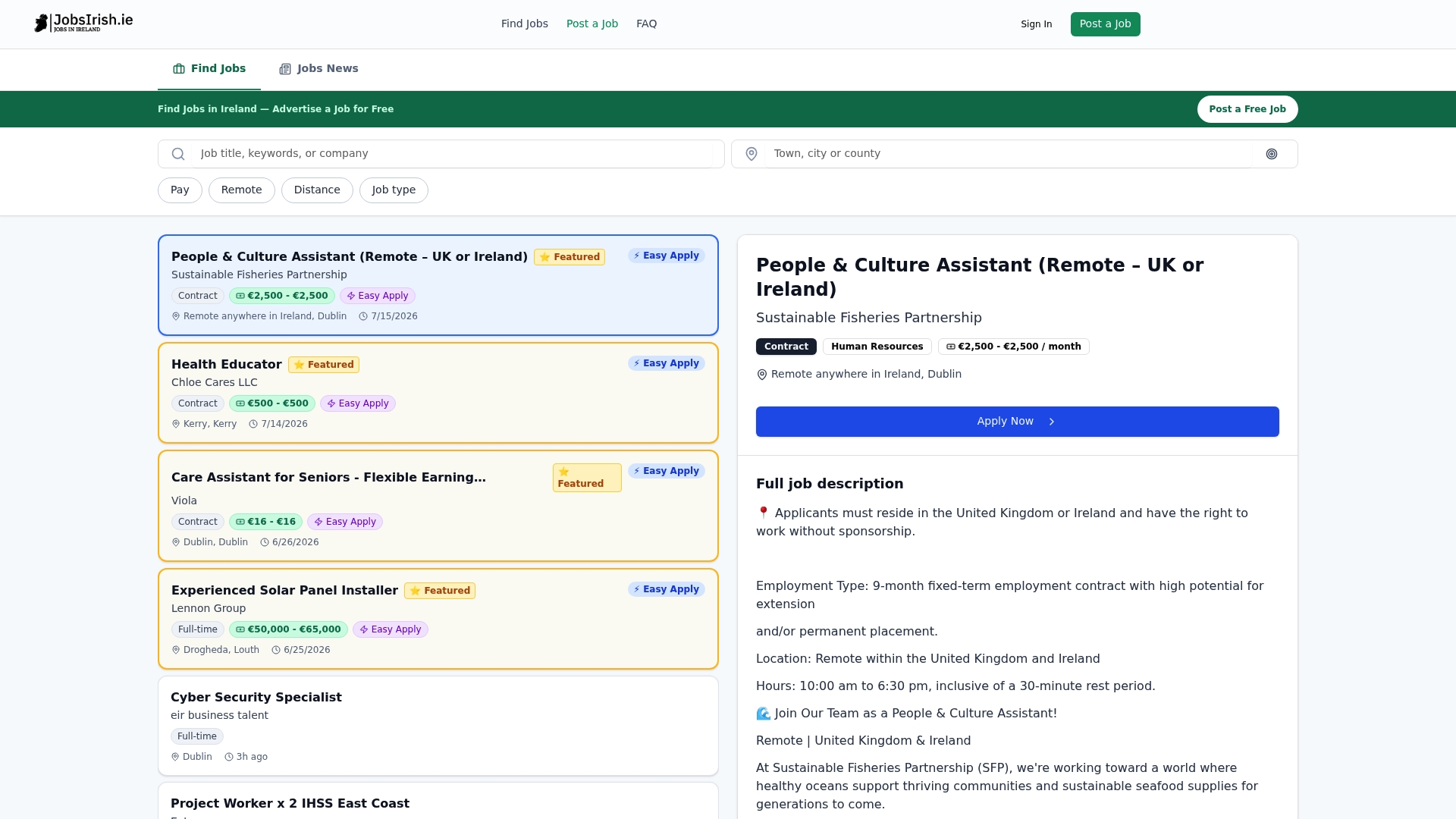
Jobsirish gives Irish employers a direct route to candidates searching by role, location, and employer type across Ireland. Listing descriptions can include policy highlights, enhanced leave terms, and flexible working options, so the right candidates see the right information before they apply. Featured listing packages give additional visibility to roles where family-friendly benefits are a genuine differentiator.
Post a role on Jobsirish and reach candidates who are actively looking for employers that take parental policy seriously.
Useful sources
Ireland:
- Citizens Information: Parental leave — entitlements, eligibility, notice rules, and application process
- Citizens Information: Paternity leave — who qualifies, how to apply, and what pay to expect
- MyWelfare: Parent's Benefit — apply for Parent's Benefit and check application windows
- gov.ie: Paternity Benefit — current rate and application timing
- Workplace Relations Commission — employee rights during leave and dispute resolution
United Kingdom:
- gov.uk — Shared Parental Leave, Statutory Maternity Pay, Statutory Paternity Pay: current rates and eligibility
- Department for Work and Pensions (DWP) — statutory pay rates and benefit interactions
- ACAS — employer guidance on notice, policy drafting, and dispute resolution
- Citizens Advice — practical guidance for employees on UK leave rights
Jobsirish:
- Jobsirish.ie — search and post Irish jobs with family-friendly policy highlights
- Job news and hiring insights — employer practices and recruitment trends in Ireland