
Qualifying employees in Ireland are entitled to statutory sick pay under the Sick Leave Act 2022, paid at 70% of normal daily earnings up to a maximum daily cap, for a limited number of statutory days per calendar year. A medical certificate from a registered medical practitioner is required from day one. The Workplace Relations Commission (WRC) enforces the scheme; Citizens Information and the Department of Enterprise, Trade and Employment provide guidance.
At a glance:
- Who qualifies: employees with at least 13 weeks' continuous service with the same employer
- How much: 70% of normal daily pay, capped at €110 per day
- How many days: 5 statutory days per calendar year (as of 2024)
- Immediate actions for employees: obtain a medical certificate; check your contract for a more favourable scheme
- Immediate actions for employers: verify service length; log the absence; calculate payment at the prescribed rate
Table of Contents
- What are the first steps for employees and employers?
- Who qualifies for statutory sick pay in Ireland?
- How much is statutory sick pay and how long does it last?
- What medical evidence do employees need to provide?
- What legal protections do employees have while on sick leave?
- What are employer obligations and what should a sick-leave policy include?
- What can you do if statutory sick pay is refused or paid incorrectly?
- Ready-to-use templates for employees and employers
- How does statutory sick pay interact with other benefits?
- Key takeaways
- Why transparent sick-leave policies matter for recruitment
- Useful sources and further reading
What are the first steps for employees and employers?
For employees
- Confirm you have completed 13 weeks' continuous service with your current employer.
- Contact your GP or registered medical practitioner and obtain a certificate stating you are unfit for work.
- Notify your employer as soon as possible and supply the medical certificate.
- Note the payment rate (70%, capped at €110 per day) and check your contract for any more generous terms.
- Keep copies of all certificates, payslips and correspondence.
For employers
- Verify the employee's start date and confirm 13 weeks' continuous service.
- Confirm receipt of the medical certificate before processing sick pay.
- Log the absence in your records: employment period, dates and times of sick leave, and the rate of payment.
- Calculate statutory sick payment at 70% of normal daily earnings up to €110 per day, or apply your contractual scheme if it is more favourable.
- Retain records for four years and ensure payroll reflects the correct calendar-year entitlement.
Pro Tip: If a sick absence begins in late December and continues into January, the calendar-year reset means the employee's entitlement refreshes on 1 January. Payroll teams should log the return-to-work date carefully and recalculate remaining days for the new year to avoid overpaying or underpaying.
Who qualifies for statutory sick pay in Ireland?
The 13-week continuous service threshold is the primary eligibility gate. The rule applies to full-time employees, part-time workers, those on probation, apprentices and agency workers alike. If an employee is re-engaged by the same employer within 26 weeks of leaving, their prior service counts towards continuity.
Employees covered by a more favourable contractual or collective scheme are not excluded from the statutory scheme; the statutory entitlement acts as the floor. Some employers offer discretionary sick pay from an earlier point in employment, so checking the contract is always worthwhile.
Key eligibility points:
- Minimum 13 weeks' continuous service with the same employer
- Applies regardless of hours worked (full-time or part-time)
- Probationary and agency workers are included
- Re-engagement within 26 weeks preserves continuity of service
Calendar-year rule: Unused statutory sick days expire at the end of each calendar year. They cannot be carried forward into the next year. Entitlement resets on 1 January regardless of how many days were taken.
How much is statutory sick pay and how long does it last?
Statutory sick pay is set at a percentage of normal daily earnings, subject to a prescribed daily maximum. The entitlement began at a certain number of days in 2023 when the scheme launched and increased to more days in 2024 by ministerial order. The Minister for Enterprise, Trade and Employment retains the power to vary the number of days further.

Employers may offer a more generous contractual scheme, such as full pay for a longer period. Where a contractual scheme is more favourable in every respect, it replaces the statutory minimum rather than sitting alongside it. For absences that extend beyond the statutory days, employees may be eligible for Illness Benefit from the Department of Social Protection, subject to PRSI contribution conditions.
Key payment points:
- Rate: a set percentage of normal daily pay
- Daily cap: a prescribed maximum amount
- Duration: a defined number of statutory days per calendar year
- Ministerial power to increase days in future years
- Contractual schemes may exceed the statutory minimum
Pro Tip: When calculating daily pay for part-time or variable-hours workers, use the average daily earnings over a representative reference period. Applying a full-time daily rate to a part-time employee is a common payroll error that can result in overpayment and a WRC compliance issue.
What medical evidence do employees need to provide?
A medical certificate from a registered medical practitioner is required from the first day of certified sick leave. The certificate must state that the employee is unfit for work; it does not need to specify a diagnosis unless the employer's contractual scheme requires it.
In Ireland, the statutory scheme does not provide a self-certification period for the first few days in the way some other jurisdictions do. Certification is required from day one for statutory sick pay to apply. Employees should obtain the certificate promptly and supply it to their employer without delay.
Evidence checklist:
- Certificate signed by a registered medical practitioner
- Certificate must confirm unfitness for work
- Required from day one of certified absence
- Employer may retain a copy; employee should keep their own copy
- For longer absences, updated certificates may be requested
Certification from day one: The WRC confirms that a medical certificate is required from the first day of illness for statutory sick pay to apply. Employees who do not supply a certificate are not entitled to statutory sick pay for that absence.
What legal protections do employees have while on sick leave?
The WRC emphasises that employees on statutory sick leave must be treated as if they had not been absent. Penalisation, dismissal or any unfavourable treatment because an employee exercised their right to statutory sick leave is prohibited under the Sick Leave Act 2022.
If an employer fails to comply, the employee may submit a complaint to the WRC. An Adjudication Officer can award compensation of up to four weeks' remuneration where entitlements are breached. Complaints must generally be submitted within six months of the alleged breach, extendable to twelve months in exceptional circumstances.
Employee protections summary:
- No detriment, dismissal or penalisation for taking statutory sick leave
- Complaint route: WRC online complaint form
- Maximum compensation: four weeks' remuneration
- Citizens Information can advise on the process at no cost
Pro Tip: Keep a written record of every communication with your employer during and after a sick absence, including emails, texts and payslip details. If a dispute arises, this paper trail is the most useful evidence an Adjudication Officer will ask for.
What are employer obligations and what should a sick-leave policy include?
Employers have four core statutory duties: pay the prescribed rate for qualifying days, treat employees without detriment, maintain accurate records, and retain those records for four years. Employers experiencing severe financial difficulty may apply to the Labour Court for an exemption from paying statutory sick pay for a period of between three months and one year.
Employer compliance checklist:
- Verify 13 weeks' continuous service before approving statutory sick pay
- Confirm receipt of medical certificate before processing payment
- Record employment period, dates and times of sick leave, and rate of payment
- Retain records for four years
- Apply the contractual scheme where it is more favourable than the statutory minimum
- For long-term absences, consider a return-to-work plan and, where relevant, seek HR or legal advice
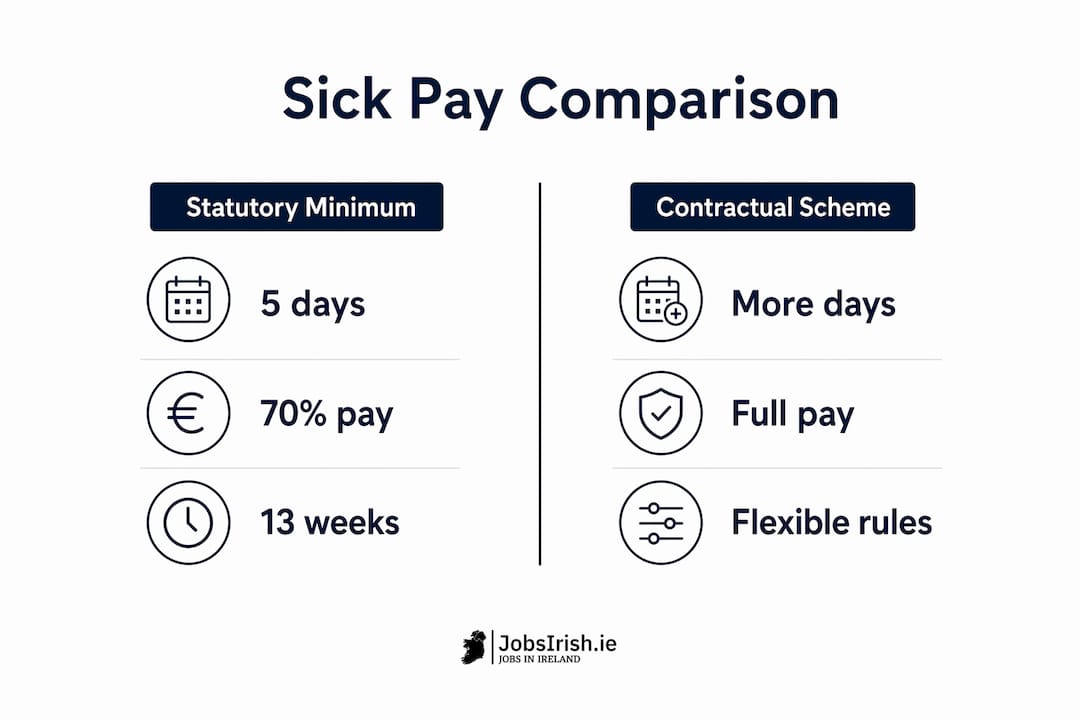
| Feature | Statutory minimum | Example contractual scheme |
|---|---|---|
| Entitlement days | 5 days per calendar year | — |
| Pay rate | 70% of daily pay, capped at €110 | Full pay for a defined period |
| Certification | From day one | From day one or after self-cert period |
| Carry-over | No carry-over between years | May allow partial carry-over |
Pro Tip: When posting a role on Jobsirish, add one sentence to the advert stating whether the position comes with a company sick-pay scheme that exceeds the statutory minimum. Candidates notice this detail, and it reduces questions during the hiring process.
What can you do if statutory sick pay is refused or paid incorrectly?
Start by raising the issue directly with your employer and asking for a written explanation. Keep a record of the response. If the matter is not resolved, the next step is a formal complaint to the WRC.
Step-by-step dispute route:
- Speak to your employer or HR contact and request a written explanation.
- Gather your medical certificates, payslips and any relevant correspondence.
- Submit a complaint via the WRC online complaint form at workplacerelations.ie.
- An Adjudication Officer will hear the case; compensation may be awarded up to four weeks' remuneration.
- For guidance before or during the process, contact Citizens Information (citizensinformation.ie) or the Department of Enterprise, Trade and Employment.
WRC adjudication: Where an employer fails to pay statutory sick pay correctly, the WRC can award compensation not exceeding four weeks' remuneration. Complaints should be submitted as soon as possible after the breach.
Ready-to-use templates for employees and employers
Employee absence notification
Employer sick-pay clause for job adverts and contracts
Employers listing roles on Jobsirish can add this clause directly to their job advert or link to their staff handbook from their Employers Directory profile, giving candidates clear information before they apply.
How does statutory sick pay interact with other benefits?
Statutory sick pay covers a maximum of a limited number of days per calendar year. For absences that run longer, employees may claim Illness Benefit from the Department of Social Protection, provided they meet the PRSI contribution conditions. Illness Benefit is not paid for the first three days of illness (the waiting period), so the interaction with statutory sick pay is important: statutory sick pay can cover those initial certified days before Illness Benefit becomes payable.
Employees with private health insurance should check their policy, as some plans include income protection or hospital cash benefits that can run alongside statutory sick pay or Illness Benefit without reducing either. Employer-provided income protection schemes operate separately from the statutory scheme and are governed by the terms of the individual policy or collective agreement.
Key takeaways
Qualifying employees in Ireland are entitled to 5 statutory sick days per calendar year at 70% of normal daily pay (capped at €110), with a medical certificate required from day one and records retained by employers for four years.
| Point | Details |
|---|---|
| Eligibility threshold | 13 weeks' continuous service with the same employer is required before statutory sick pay applies. |
| Payment rate and cap | Statutory sick pay is 70% of normal daily earnings, up to a maximum of €110 per day. |
| Days entitlement | Employees are entitled to 5 statutory sick days per calendar year; unused days do not carry over. |
| Medical certificate | A certificate from a registered medical practitioner is required from the first day of certified absence. |
| Record retention | Employers must retain sick-leave records for four years; failure to do so risks enforcement action by the WRC. |
Why transparent sick-leave policies matter for recruitment
Sick-leave policy is one of those details that candidates notice but employers often leave out of job adverts. When a role clearly states whether it offers statutory minimum or a more generous scheme, candidates can make an informed decision before applying. That reduces drop-off at offer stage and builds trust from the first point of contact.
At Jobsirish, employers can post roles with full benefit details, including sick-pay arrangements, directly in the advert. Adding that one sentence about your sick-pay scheme costs nothing and signals that your organisation takes employee welfare seriously. Employers wanting to attract candidates across Ireland can post a job today or update their Employers Directory listing with current policy information.
Useful sources and further reading
- Sick Leave Act 2022, Irish Statute Book: the primary legislation setting out entitlement, prescribed rates and ministerial powers
- Workplace Relations Commission: Sick Leave: enforcement body guidance, complaint forms and adjudication information
- Citizens Information: Sick leave and sick pay: plain-language guide to eligibility and employee rights
- Department of Enterprise, Trade and Employment: Statutory Sick Leave assessment: policy background and employer guidance
- Department of Social Protection: Illness Benefit (gov.ie): PRSI-based benefit for absences beyond the statutory sick-pay period
- Jobsirish Employers Directory: list your organisation and display your sick-pay policy to candidates
- Post a job on Jobsirish: advertise roles with clear benefit and sick-pay details across Ireland
This article provides general information about statutory sick leave in Ireland and is not legal or professional advice. Verify current rules with the Workplace Relations Commission, Citizens Information or a qualified employment law adviser for your specific situation.